The advisors who figure this out first are going to own the next twenty years.
A referral without making your client do the referring. That's the simple idea that will change your business forever.
It's a little after two in the morning and you're standing in your kitchen in the dark because you got up for water.
The refrigerator hums and the thought hits you sideways, same way it always does when there's nothing else in your head to block it.
What if I'm the last generation of people who do this job?
An app does the allocation now. A robo does the rebalancing. A chatbot answers the questions your clients used to pick up the phone for, and it answers them at eleven at night, patiently, for free, without ever needing to reschedule.
Your best client's son has never met a person who charges money for financial advice and he cannot construct a reason why anyone would.
You've seen this movie. Travel agents. Stockbrokers. Bank tellers. Everybody who used to stand between a customer and the thing the customer wanted.
You go back to bed. In the morning you do the thing that feels like an answer. In the morning you buy a list, or book a room, or write another post.
That's been the answer my entire career. Finding the people is problem one. Finding the money is problem two. Keeping both is problem three. Everything else in this business is a footnote to those.
So look at what we've all been handed to solve problem one.
The ones who show up on time. Who do what you tell them to do. Who bring their spouse. Who moved everything over without being asked twice and have never once brought up your fee.
Where did they come from?
If any of them came off a purchased list or a rubber chicken dinner, you've solved something the rest of this industry hasn't, and you should close this page and go on doing exactly what you're doing.
I'd bet on a different answer, because it's the same answer in every practice I've ever looked inside. They came from a person. Somebody they trusted said your name in a room, with some warmth in their voice, and the trust arrived before you did.
"You walked into that first meeting already hired. Everything after that was paperwork with coffee."
That's the highest-quality client acquisition event in this business. It has been for a century and it will still be true in another hundred years, long after the machines are doing the rebalancing.
And you have no way to make it happen.
You can hope. You can put we grow by referral on the website. You can get to the end of a good review meeting, feel your pulse spike, and ask the question you hate asking, and hear the client say sure, let me think about who might be a fit, which every advisor alive knows is a polite way of saying no.
The best thing in your business is the one thing you don't control.
What if you could build the introduction yourself? Not hope for it or hint at it. Build it, in under a minute, for a specific person whose name you write down.
Everything under this line is how it works.
You know what Currence does. I built it because advisors needed a real way to manage what a household actually keeps, and it already does that better than anything else in the market.
Then I watched something that bothered me for years. Advisors running the best system in the industry still couldn't find enough people to run it on.
Currence solves problem two. Finding the money. It does nothing at all for problem one. So I built the other half.
And I didn't build it alone, which is why the end result is so incredible.
I know money. Books are a different trade, and a book that reads like an advisor wrote it gets set down at chapter two. This whole system depends on a stranger finishing the book. So before anything else existed, I went and got the best writer I could find.
Though really, the word "writer" doesn't even begin to cover it.
Sean Platt has spent his career making books people finish. He founded a publishing company and sold scripts and IP to Hollywood. Before and after that, business owners have paid him six figures to alchemize their knowledge into world changing ideas. As a ghostwriter, he's worked with Academy Award winning producers and #1 NY Times bestselling authors. I bet he's written at least one book you've read without ever knowing it was him.
I showed him the Smarter Money Method and we've spent the last year developing this advisor program together.
One more thing about Sean. He deals in IP at the highest level, and the only way his writing gets near a financial practice now is through Smarter Money. I am not modest about having locked that up.
If you're using Currence today, you have a system that makes you extraordinary once somebody is sitting in front of you. What you don't have is a reliable way to get them there.
That's what this is.
"Currence moves the money. Smarter Money moves the people. Together they're a future-proof practice."
That might sound like a mailing service until you look at what everyone else is doing. Every advisor in your market is fighting for a slot in the same feed. Same LinkedIn post, same newsletter, same two seconds of a thumb doing its work to scroll right by.
You're all shouting into a room where the volume has already been cranked up as high as it goes. I refuse to help you shout louder. I'm going to do what no one else is going to do by walking you around the back and helping you to knock on the door.
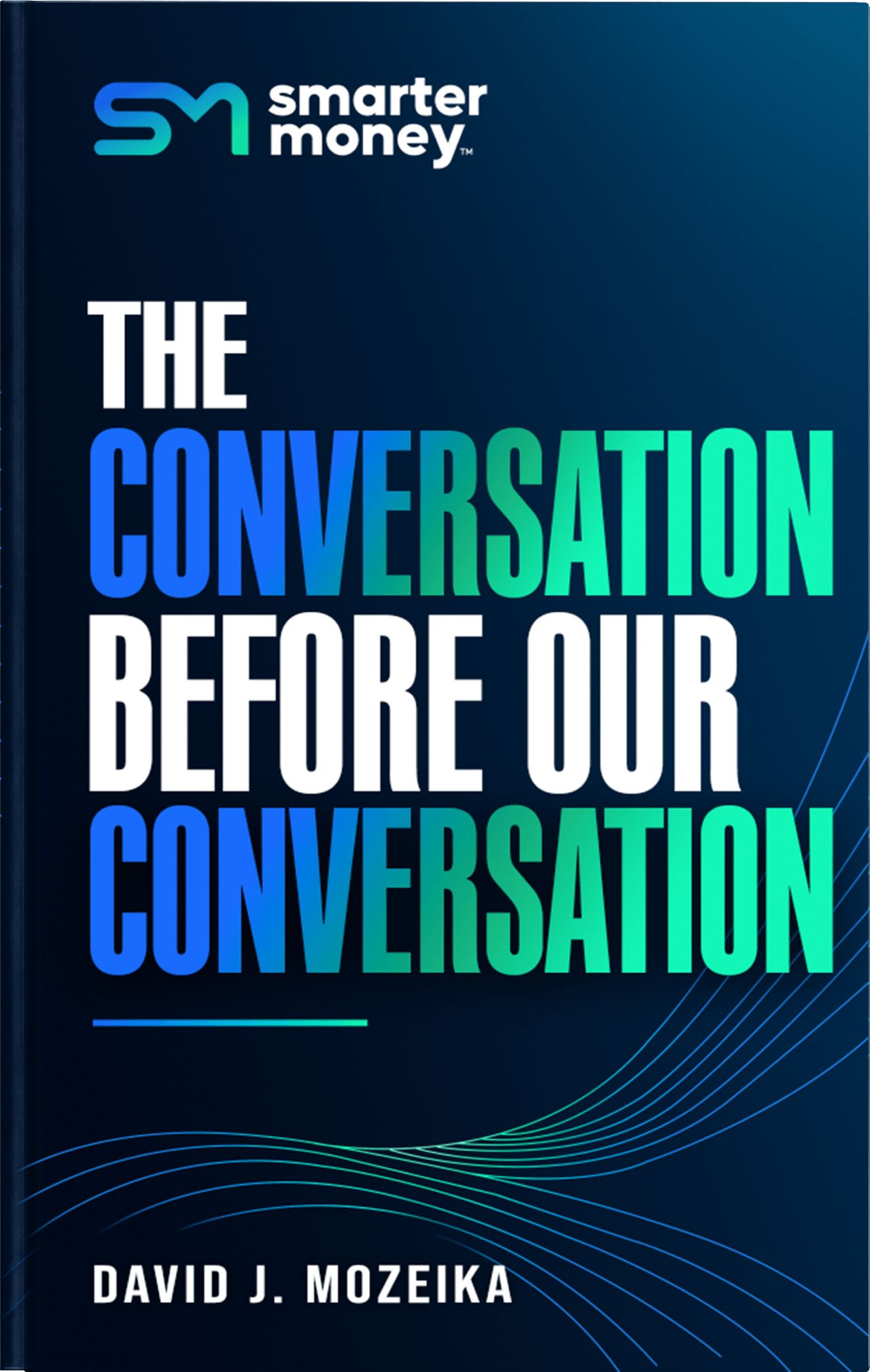
The book is called The Conversation Before Our Conversation. Gorgeous hardcover, about a hundred pages, reads in under an hour. This isn't a brochure with a spine.
It teaches one idea. Most people spend their entire financial life being measured on what they managed to keep, while the far larger number, everything that moved through their hands over a working life, goes unwatched.
The book shows a reader that number, then shows them the mechanics of catching it. No products, no recommendations, no pitch. A person finishes it and understands something about their own money that they did not understand that morning.
It softens the market in front of you. Somebody who reads this arrives at your first meeting already thinking the way you need them to think, which means you spend that hour on their situation instead of on their education.
Inside the book is a bookmark with a note from you on the face, and your contact and booking code on the back. The reader knows who sent their gift before the first sentence. Then the bookmark travels through the book with them, holding their place, putting your name in their hand every time they sit down to read. By the night they finish, the next step is already between the pages.
Those are yours to hand across a desk; put on every seat at your seminar; leave with someone in the parking lot after a meeting. Give a man a hardcover book and watch what he does with his hands. He'll turn it over. He'll look at the back. He'll hold onto it while he's talking to you. Nobody has ever done that with a business card.
Under a minute. We print your bookmark, tuck it inside, box the book, and mail it on your behalf.
That is a different phone call than the one you've been making. On a cold call you have about eleven seconds to prove you're not a scam. On this one you're a guy asking about a book that's sitting on their kitchen counter right now, which they've either read or feel slightly guilty about not reading yet. Either way, they talk to you. You do it again next month.
Not a postcard with a lighthouse on it. Or some stupid flyer with a smiling couple on a dock. A hardcover book, with a note tucked inside, from somebody who thought of them.
A hardcover doesn't enter a house the way advertising does. Cheap things get sorted on the walk in from the mailbox and go straight in the recycling. A book ends up on the table. Try throwing one away sometime and notice how long your hand hovers.
So it sits there. Then it's Thursday night and they're burned out on Netflix. The book you sent is sitting right there. And it's short. They open it.
An hour later they know why the last twenty years felt like running uphill even though they've done well. Their spouse is asleep. They're sitting in a quiet house with a book in their lap thinking about their own money in a way nobody has ever framed it for them before.
And your bookmark is holding their place.
You just spent sixty uninterrupted minutes in that person's head. In their house, in their chair, at the hour they chose. You didn't interrupt them. And you didn't buy their attention. They handed it to you.
"Everybody else in your market is a notification. You're the thing on their table."
Something is going to be scarce in this business, and it isn't information. Information has already collapsed. Anything a client wants to know is thirty seconds away, explained clearly, for free, by a machine that never gets tired of the question.
That was your value for a long time and now it's gone. You feel it, which is why you were standing in the kitchen at two in the morning.
What gets scarce is trust. Not the word on your website. The real thing, the kind that transfers from one human to another and makes somebody move money.
Everything digital is about to be assumed fake, because most of it will be. Every email is generated. Every post is generated. Every video will be sooner than any of us would like. The default response to anything on a screen is going to be a small reflexive who made this and why.
A physical object answers that question before it's asked. A hardcover carries a cost signal that nothing on a screen can carry. Somebody paid to print this. Somebody paid to mail it. Somebody put their name inside and expects it to stay in the house.
An email costs nothing and everyone knows it costs nothing, which is why it will always get treated like it costs nothing.
The advisors who understand this are moving now, quietly, and there aren't many of them. I've spoken at a lot of conferences and sat in a lot of rooms full of people who do what I do. I can count the ones running this play without getting past one hand.
If I were you, I'd read that sentence again.
The mechanics here aren't complicated enough to stay quiet for long. The thing worth having is the twelve months of head start before the rest of our industry starts figuring this out.
Every edge in this business has a window. That window is wide open when nobody's doing it, then it narrows while a few people get rich, and finally closes when it turns up in a compliance-approved template that every advisor at your firm gets emailed on the same Monday.
The window on this one is open right now.

Coffee's cold. Papers are back in the folder. You've got your hand on the door. You turn around and say this:
"Who else needs to read this? I'm an advisor, and honestly I feel like it's my obligation to get this in front of people. There might be somebody you thought about while you were reading it. Can you nominate them? I'd love to send them a book. And do you mind if I use your name?"
They think for a second. Then they give you a name.
Notice what you didn't ask for. You didn't ask for business. You asked who deserves a book. That's a question people enjoy answering, which is the entire reason it works when the other one doesn't.
And notice what your client has to do. Nothing. Nobody forwards an email. Nobody composes an introduction they'll put off for three weeks. Nobody sets up an awkward group text. They say a name out loud, and you write it down.
You type it into the portal that night. Four days later a hardcover book lands at a second house. You call, and the first words out of your mouth are Joe suggested I send you that.
That's a personal introduction. It took you one question and sixty seconds of typing to build it. Then you ask the same thing at the end of the next meeting. And the one after that.
Five a month is sixty households a year before a single nomination. Sixty people who spent an hour with your name in their hands, every one of whom you had a reason to call.
Then the question starts working. Not every time. Some months nobody gives you anybody. Some months you ask it poorly and it lands with a thud and you feel it. Some months one meeting hands you four names and you can't type fast enough.
But every name that comes back arrives warmer than the one that started it, because somebody vouched. And every book that goes out to a nominated name is another chance to ask the question again.
That's the whole engine. It has one input you control, which is whether you asked, and one output that stacks up whether you're paying attention or not.
I'm not going to hand you a projection. I don't know your market, your follow-through, or how that question is going to sound coming out of your mouth the first few times. But I will tell you what actually matters.
A year of this costs you $2,787. If one household out of those sixty becomes a client, you're ahead. Not a great year. Not a home run. One client, and everything after that is profit for as long as you run it.
You'd have to work at being bad to get one out of sixty.
They're discounted because these thirty pay for the print run and help me build the proof I'll use to sell this at full price later.
The ingredients are not in question. Books hold attention in a way nothing else in your marketing budget does. Introductions transfer trust. A specific gift creates a reason to call that doesn't exist otherwise. Referral asks land better when they're concrete. All of that is old and none of it is controversial.
This pilot tests whether packaging those pieces into this exact workflow, at this cadence, produces what I think it produces. That's what the thirty are for. You're not buying finished case studies. You're helping make them, and that's why you're paying a third of what this will ultimately cost.
With a QR code to your booking link.
Yours to hand over in person. Keep a stack in the office for the meetings you already have on the calendar, and the ones that happen without warning.
The Send Playbook, a walkthrough of the whole motion end to end. The gift one-pager, the follow-up scripts, and the nomination script. Your first month of sends.
You give the names, we handle the bookmark, the packaging, and the postage. Find ten-send blocks at $249, on top of your monthly five, whenever you want to move faster. Or buy a stack outright to hand out yourself, at $20 a book, fifty minimum.
| Seats | Setup |
|---|---|
| Standard · 51 and after | $2,999 |
| Early Access · 41 through 50 | $1,999 |
| Early Access · 31 through 40 | $1,499 |
| Founding 30 · 1 through 30 | $999 |
Founding means thirty. When the thirtieth seat goes, the founding price is gone and it will never come back.
Your numbers. Books sent, follow-ups made, meetings booked, nominations collected. What worked when you asked the question and what died in your hands.
You get this at a third of what it will ultimately cost and I get the proof. If reporting your numbers is going to irritate you, take a seat later at full price and we'll both be happier.
No term on the monthly. Cancel anytime. The books stay yours.
You have a client list, a phone full of contacts, a whole generation of your clients' kids who are about to inherit something, and a dozen prospects who went quiet after a second meeting and aren't offended, just busy. Start with five people who already like you. The nomination question handles the rest.
There are no performance claims in the book, testimonials, or product recommendations. Nothing about a specific security or strategy. It teaches a cash flow concept in hedged language with the disclosures in the back. It was written with review in mind, because I have to clear review too. Submission is still yours, and if your firm says no, you get your setup back.
Then write one. I mean that, and I have a way to help you do it that we should talk about separately. While you're writing it, understand what you're choosing. A book takes most people eighteen months and plenty never finish. The advisor who takes a seat today has ninety households behind him by the time your manuscript reaches a designer.
No. A box of books with no bookmark, no portal, no scripts, and no nomination motion is a gift. The book isn't what you're buying. It's what makes the phone call welcome.
You're not buying five books. If books were the product I'd sell you a case and we'd both be disappointed in six months. You're buying the thing around them. Somebody else prints your bookmark, packs the box, pays the postage, and keeps the whole motion running while you do your actual job. You're buying a system that turns one question at the end of a meeting into a book on a stranger's table four days later. You're buying a position in a small group of advisors who work this way, at a moment when almost nobody does. And one client covers the year. If you can't clear that on a household, the problem isn't my pricing.
The portal takes under a minute. If you already know you'll ignore this for six months, don't take a seat. I'd rather run this with twenty advisors doing the work than thirty on a list.
Cancel. There's no term on the monthly, the books stay yours, and the setup terms are up above. What you can't do is run the program for five weeks, decide nothing happened, and hold me to a twelve-month curve on a five-week timeline. I told you what this is at the top of the page.
Twenty-five years as an advisor. Top one percent of the industry. Forbes recognized. I built the method the book teaches, I've run it with people who paid me real money to run it, and I'm sending these books out of my own practice at the same time you are.
Direct mail is one of the most powerful things in existence and almost everyone does it poorly, which is why you think it doesn't work. It fails when a stranger interrupts you and asks for something before you've given anything. That's a guy at your door holding a clipboard. This is a friend leaving a book on your porch with a note about why it made him think of you. Same postal service. Nothing else about it is the same.
It's a print run and a fulfillment window, and I need a group small enough that I can get all of them on a call. When it fills the price moves, and I'll say so publicly when it does.
No judgment in any of that.
You've sent a minimum of sixty books. More than that once the question started working for you. Sixty households where a hardcover with your name in it sat on a counter for a week and then got read on a quiet night. Some of those people are clients now. Some aren't and handed you a name anyway. One of them will call you in month fourteen out of nowhere, which happens with books more than you'd expect.
You have a list that no vendor can sell and no competitor can copy, because copying it means starting a year ago. And that two in the morning thought doesn't come anymore. The industry didn't get any safer, but you stopped being an advisor competing on twenty years of experience and a fiduciary standard and a personalized approach, which is what every single person in your market claims about themselves.
Claim a Founding SeatIf you take nothing else off this page, take the question. Who else needs to read this? Can I use your name? It costs you nothing, it lives at the end of a meeting you were already having, and it's the closest thing to a free lunch I've found in a quarter-century of doing this. Ask that question tomorrow. You don't have to buy anything from me to do that.
The first print run ships the last week of October. Seats claimed after it goes out get their books in the next run. Setup also goes to $1,499 at seat thirty-one and $1,999 at seat forty-one. It's full price from fifty-one on.
In three years every smart advisor in your market will be mailing something. The ones who started this fall won't have to.